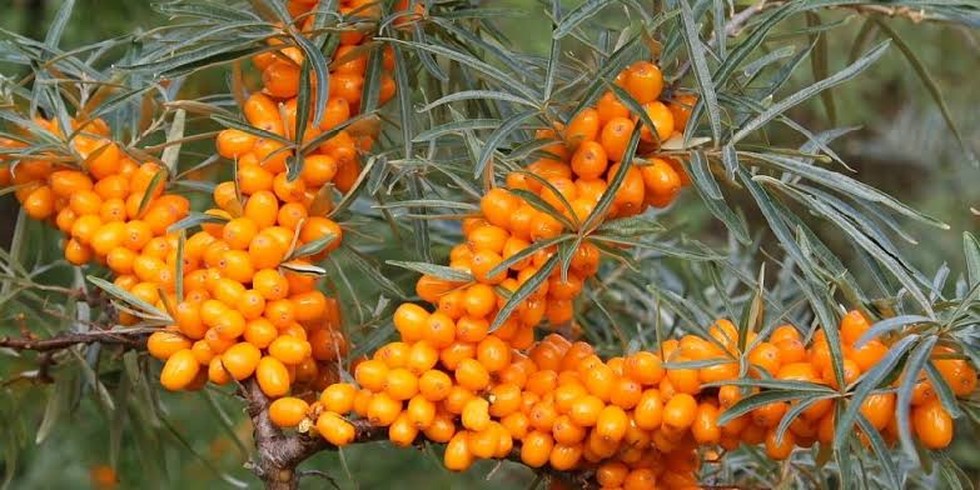
Recently, Spiti’s seabuckthorn has been granted the Geographical Indication (GI) status.
About Seabuckthorn:
It is popularly known as the ‘Wonder Plant’, ‘Ladakh Gold’, ‘Golden Bush’, or ‘Gold Mine’ of cold deserts.
It is an important plant of trans-Himalayan region that belongs to the family Elaegnaceae.
Distribution: Sea buckthorn (Hippophae rhamnoides) is a plant found throughout Europe and Asia.
In India, it is found above the tree line in the Himalayan region, generally in dry areas such as the cold deserts of Ladakh and Spiti.
It produces small orange or yellow-coloured berries that are sour in taste but rich in vitamins, especially vitamin C.
Sea Buckthorn berries have a unique characteristic of remaining intact on the shrub throughout the winter months despite the subzero temperature.
Climatic and soil requirements Sea buckthorn:
It is a temperate shrub.
It can withstand a wide range of temperatures from -43 to 40°C. This unique feature enables the species to adapt very well in harsh climatic conditions.
The dense and thorny bushes of sea buckthorn are salt tolerant and demand full sunlight for growth.
Ecological Importance:
The shrub develops an extensive root system having ability to fix atmospheric nitrogen.
It is an ideal plant for soil erosion control, land reclamation, wildlife habitat enhancement and farm stand protection in temperate regions.
Dear Student,
You have still not entered your mailing address. Please enter the address where all the study materials will be sent to you. (If applicable).