
Upcoming Mentoring Sessions

Optional Doubt Session
RMS - World History & Post-Independence
RMS - Human & Economic Geography
RMS - Indian Society - Part II
RMS - Indian Society - Part I
News Reading Hour
RMS - Disaster Management
RMS - Environment
RMS - Internal Security - Part II
RMS - Internal Security - Part I
RMS - Social Justice - Part III
RMS - Social Justice - Part II
RMS - Social Justice - Part I
RMS - International Relations
RMS - Governance - Part II
RMS - Governance - Part I
Mentorship Program Introductory Session
RMS - Indian Physiography - Archipelagos of India
RMS - Indian Physiography - Coastal Plains of India
RMS - Art & Culture - Bhakti Movement
RMS - Polity - Elections & Political Parties
RMS - Indian Physiography - The Great Indian Desert
Step-Up RMS - Economic Survey and Budget : Part - 2
Step-Up RMS - Resources - Forests, Soils, Minerals etc : Part - 2
Step-Up RMS - Environment and Biodiversity Current Affairs : Part - 2
Step-Up RMS - History : 1935 - Independence
Step-Up RMS - Science and Technology Current affairs - Part - 2
Step-Up RMS - History : 1921 - 1935
RMS - A&C - Current Affairs
RMS - Indian Physiography - Peninsular Plateau
RMS - Polity - Services under the Union and the States & Pressure Groups
RMS - Economy - Balance of Payments
RMS - Economy - Trade & Important Government Schemes
RMS - Modern History - 1830 AD to 1857 AD
RMS - Economy - Fiscal Policy & Budgeting
RMS - Economy - Inflation
RMS - Polity - Local-Self Government & Co-Operative Societies
Step-Up RMS - Environment and Biodiversity Current Affairs : Part - 1
Step-Up RMS - Science and Technology Current affairs - Part - 1
Step-Up RMS -History : 1906 - 1920
Step-Up RMS - History 1857-1905
Step-Up RMS - Geomorphology - Types and Distribution
Step-Up RMS - Evolution + Interior of earth + oceanography
Step-Up RMS - History - Constitutional reforms
Step-Up RMS - Medieval History - kingdom chronology + terminology (Part - 2)
RMS - Indian Physiography - The Great North Indian Plain
RMS - Indian Physiography - Intro & The Himalayas
Step-Up RMS - Indian geography - location , landforms
Step-Up RMS - Drainage system + Rivers (India and world)
RMS - Art & Culture - South India
RMS - Economy - Taxation
RMS - Economy - Money and Banking - Part II
RMS - Polity - Union Legislature - Part III
Step-Up RMS – Indian Culture: Architecture + Literature (Part-2)
Step-Up RMS - Human geography
Step-Up RMS - Delhi sultanate + mughal administration
Step-Up RMS - Resources - Forests, Soils, Minerals etc
Step-Up RMS - Climatology + Indian monsoon
Step-Up RMS - Medieval History - kingdom chronology + terminology
Step-Up RMS - Indian school of philosophy -Buddhism & Jainism
Step-Up RMS - Indian Culture : Architecture + literature
Step-Up RMS - Ancient history - chronology + terminology
Step-Up RMS - Economic Survey and Budget
Step-Up RMS - Polity - Miscl-Imp Judgements , Amendments, Miscl concepts etc
Step-Up RMS - Agriculture and related concepts
Step-Up RMS - Polity - Constitutional and Non-Constitutional Bodies
Step-Up RMS - Economics - External Sector
Step-Up RMS - Polity - Judiciary- SC/HC/Lower courts
Step-Up RMS - Economics - Fiscal policy and Financial Markets
Step-Up RMS - Polity - Parliament and State Legislature
Step-Up RMS - Economics - Money and Banking
Step-Up RMS - Polity - Union and State Executives
Step-Up RMS - Economics - Basic Economics and Terminology
Step-Up RMS - Polity - State, Citizenship, FR/FD and Emergency Provisions
RMS - Polity - Judiciary - Part II
RMS - Geography - Biomes and Natural Resources
RMS - Economy - Money and Banking - Part I
RMS - Geography - Oceanography
RMS - Medieval History - 646 AD to 1192 AD
RMS - Art & Culture - Post Mauryan Period
RMS - Polity - Union Legislature - Part II
RMS - Economy - Financial Markets
RMS - Polity - Judiciary Part I
RMS - Polity - Separation of Powers & Federal System
RMS - Geography - Atmospheric Circulation
RMS - Polity - Union Legislature - Part I
RMS - Geography - Air Mass, Fronts & Cyclones
RMS - A&C - Pre-Historic to Mauryan Period
RMS - Economy - Fundamentals of Economy & NIA
RMS - Polity - Emergency Provisions
RMS - Geography - Humidity, Clouds & Precipitation
RMS - Economy - Demography, Poverty & Employment
RMS - Modern History - 1813 AD to 1857 AD
RMS - Polity - Union & State Executive
RMS - Modern History - 1932 AD to 1947 AD
RMS - Geography - Basics of Atmosphere
RMS - Polity - Fundamental Rights - Part III
RMS - Economy - Planning and Mobilisation of Resources
RMS - Modern History - 1919 AD to 1932 AD
RMS - Modern History - 1757 AD to 1813 AD
RMS - Economy - Financial Organisations
RMS - Geography - Major Landforms
RMS - Polity - Constitutional and Statutory Bodies
RMS - Geography - EQ, Faulting and Fracture
RMS - Polity - Fundamental Rights - Part II
RMS - Economy - Industry, Infrastructure & Investment Models
RMS - Polity - DPSP & FD
RMS - Economy - Indian Agriculture - Part II
RMS - Geography - Rocks & Volcanoes and its landforms
RMS - Geography - Evolution of Oceans & Continents
RMS - Polity - Fundamental Rights - Part I
RMS - Modern History - 1498 AD to 1757 AD
RMS - Modern History - 1858 AD to 1919 AD
RMS - Geography - Interior of the Earth & Geomorphic Processes
RMS - Geography - Universe and Earth and Basic concepts on Earth
RMS - Economy - Indian Agriculture - Part I
RMS - Economy - Fundamentals of the Indian Economy
RMS - Polity - Union & its territories and Citizenship
RMS - Polity - Constitution & its Salient Features and Preamble
Learning Support Session - ANSWER writing MASTER Session
Learning Support Session - How to Read Newspaper?
Mastering Art of writing Ethics Answers
Mastering Art of Writing Social Issues Answers
Answer Review Session
UPSC CSE 2026 Form Filling Doubt Session
Mentoring Session (2024 - 25) - How to Write an ESSAY?
Social Issues Doubts and Mentoring Session
Ethics & Essay Doubts and Mentoring Session
Geography & Environment Doubts and Mentoring Session
History Doubts and Mentoring Session
Economy & Agriculture Doubts and Mentoring Session
Online Orientation Session
LIVE NEWSPAPER READING SESSION
Mains Support Programme 2026-27
Mains Support Programme 2025- (1)
Polity & International Relations Doubts and Mentoring Session
Mentoring Sessions (2024-25) - How to DO REVISION?
Learning Support Session - How to Start Preparation?
RMS - Geography - World Mapping
Mentoring Session (2024-25) - How to Make Notes?
General Mentoring Session (GMS )
Mentoring Session (2026-27) - How to write an Answer?
Upcoming Live Classes

How to evaluate your own Mains Answers
Start Time : Oct. 24, 2026, 2:30 p.m.
Teacher : Vajiram And Ravi
Subject : General Studies
MAINS CAMP- 75 Days Hard Challenge
Start Time : Oct. 24, 2026, 5 p.m.
Teacher : Vajiram And Ravi
Subject : General Studies
Introductory Class to Essay
Start Time : Oct. 25, 2026, 11 a.m.
Teacher : Brijendra Singh
Subject : Essay


















Current Affairs
Oct. 22, 2026
Key Facts about Kushiyara River
The banks of Kushiyara River, which separates India and Bangladesh along the Sribhumi district, came alive recently as thousands of devotees gathered on both sides of the international border for the immersion of Durga idols on Vijayadashami.
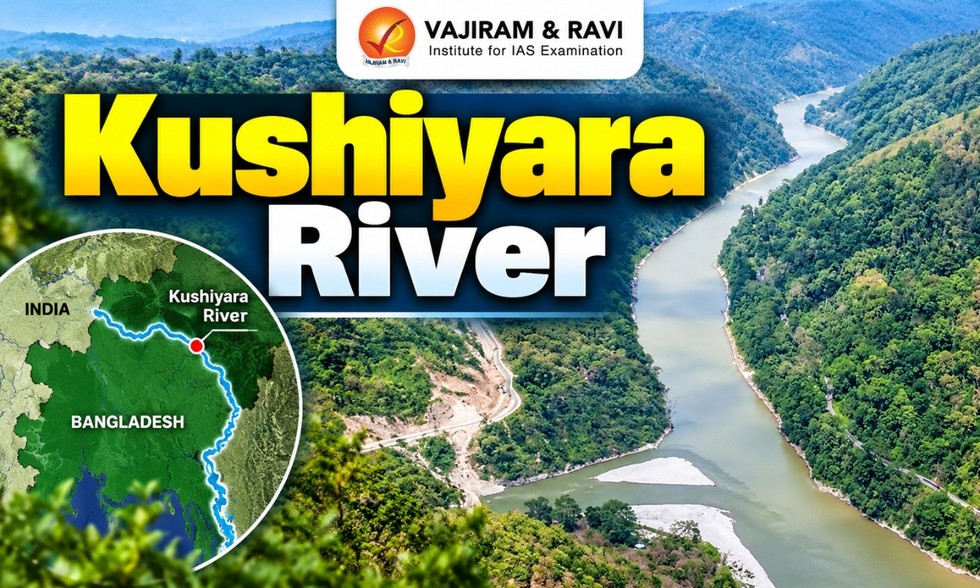
About Kushiyara River:
- It is a transboundary river between India and Bangladesh.
- It is a distributary of the Barak river.
- Course:
- It originates at the India-Bangladesh border as a branch of the Barak River, known as the Amlshid bifurcation point.
- Flowing westward, the River forms the boundary between Assam, India, and the Sylhet District of
- Along its course, it passes through towns like Zakigonj, Sylhet, and Karimganj, Assam, before entering entirely into the Beanibazar Upazila of Bangladesh.
- The river then meanders southwestward, passing several villages and eventually joining the Meghna River.
- The Kushiyara River receives contributions from various significant tributaries, including:
- Juri River (from the east)
- Manu River (Monu River) (from the south)
- Itakhola River
- In 2022, India and Bangladesh signed the Kushiyara River Water Agreement, which represents a critical turning point in their water-sharing relationship.
- This is the first water-sharing agreement between India and Bangladesh since the historic Ganga Water Treaty of 1996.
- The agreement aims to address the problems of seasonal water scarcity and flooding in both Assam, India, and Sylhet, Bangladesh.
- This allocation ensures adequate water for irrigation in Sylhet’s dry-season (Boro) rice cultivation.
- The water of Kushiyara will be channelled through the Rahimpur Canal project in Sylhet.
- Unlike the Teesta River dispute with West Bengal, the Kushiyara agreement does not require state-level approval from Assam.
Geography
Current Affairs
Oct. 22, 2026
Key Facts about eMudhra Limited
The Ministry of Electronics and Information Technology (MeitY) recently formed a special team to investigate the leak of private keys associated with web security certificates issued by Bengaluru-based eMudhra.

About eMudhra Limited:
- It is an Indian digital trust company that provides digital certificates and services for verifying identities and securing online transactions.
- It operates as a certificate authority (CA), an organisation that issues digital certificates to help websites and other entities prove their identity online.
- A digital certificate works much like an identity card for a website.
- When someone visits a banking website, for example, the browser checks its certificate to help establish that it is connecting to the genuine website rather than an impostor.
- CA’s issue these certificates, which browsers use to determine whether a website's identity can be trusted.
- eMudhra also provides digital signature certificates and electronic signing services that allow people and businesses to sign documents online.
- The company is listed by the Controller of Certifying Authorities (CCA), the government body responsible for licensing and regulating certifying authorities in India.
- eMudhra is also associated with Aadhaar-linked electronic know-your-customer (e-KYC) services, according to the Unique Identification Authority of India (UIDAI).
- eMudhra is not the only company authorised to issue digital certificates in India.
- The CCA's list includes other providers such as Protean, C-DAC, Capricorn and VSign
- Their services vary, but they operate within India's regulated digital-signature ecosystem.
Why Do Websites Need Security Certificates?
- When someone visits a website, the browser needs to check that it is connecting to the genuine website and that information exchanged with it is protected from being read or altered by others.
- This is where HTTPS (Hypertext Transfer Protocol Secure) comes in.
- It helps secure the connection between a website and a browser using a system called Transport Layer Security (TLS).
- As part of this process, the website presents a digital certificate that helps the browser verify its identity.
- The digital certificate links the website's name to a public key, while the website keeps a matching private key secret.
- The browser checks the certificate to see whether it was issued by an authority it trusts and whether it is valid.
- If these checks succeed, the browser can establish an encrypted connection.
- This helps protect information such as passwords, payment details and private messages as they travel across the internet.
- However, a secure connection does not guarantee that a website is legitimate or that its content is safe.
- It helps confirm the website's identity and protects information exchanged with it, but a fraudulent website can also have a valid security certificate.
Economy
Current Affairs
Oct. 22, 2026
What is Agrivoltaics?
Operationalising just 10% of the agricultural land deemed suitable for agrivoltaics in India could generate enough electricity to meet the country’s projected power demand for 2050, Union Minister for New and Renewable Energy (MNRE) said recently.
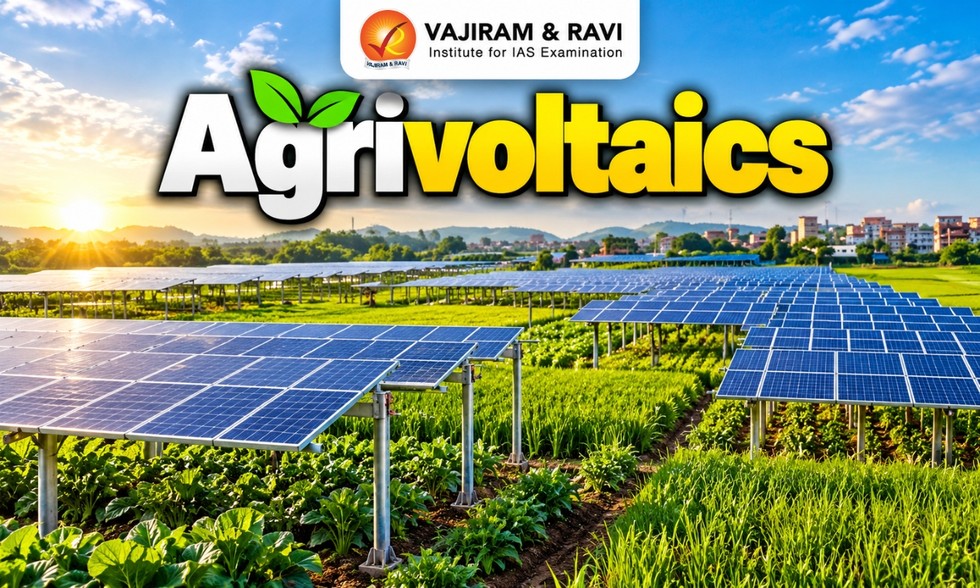
About Agrivoltaics:
- Agrivoltaics, also known as Agri-Photovoltaics (AgriPV), agrisolar, or dual-use solar, is the practice of utilizing the same land for both farming and solar power generation.
- This combination helps address two pressing issues: clean energy production and sustainable agriculture.
- The idea of agrivoltaics has been around since the 1980s. After the turn of the millennium, the concept of agrivoltaics was put into practice and researched in pilot plants, first in Japan, then in Germany and France.
- However, it is only in recent years that the implementation of this concept of agrivoltaics has gained momentum.
- Agrivoltaics designs vary depending on crop type, geography, and climatic conditions:
- Elevated systems: Solar panels are mounted several metres above the ground, allowing normal farming below.
- Row-based systems: Panels are placed between crop rows to reduce shading impact.
- Vertical systems: Upright panels capture sunlight from both sides, suitable for certain crops.
- Greenhouse-integrated systems: Panels are incorporated into greenhouse structures to regulate light and temperature.
- Agrivoltaic systems can create unique microenvironments that benefit both energy generation and crop growth:
- Improved Water Efficiency: The shade from solar panels reduces evaporation, helping soil retain moisture for longer periods. Studies indicate water savings of up to 30% in agrivoltaic setups.
- Temperature Regulation: Partial shade from panels helps maintain optimal temperatures for certain crops, particularly during intense summer heat.
- Enhanced Plant Growth: Many crops, especially shade-tolerant varieties, show improved yields when grown under solar panels due to reduced heat stress and better water retention.
- Agrivoltaics Status in India:
- Agrivoltaics in India is currently at a nascent and pilot-based stage, with nearly 50 installations across the country experimenting with different crop–panel combinations and assessing their economic viability.
- The MNRE estimates that an extra 630 GWp of solar power could be produced by putting solar panels on just 1% of India's agricultural land.
Science & Tech
Current Affairs
Oct. 22, 2026
What is the Badr Memorandum of Understanding (MoU)?
Pakistan, Turkey, Qatar, and Indonesia recently signed the Badr Memorandum of Understanding (MoU) seeking deeper military cooperation and joint production.

About Badr Memorandum of Understanding (MoU):
- It is a new defence cooperation agreement signed by Turkey, Qatar, Pakistan, and Indonesia.
- The agreement aims to expand cooperation in military production, research and development, technical training, and joint military exercises.
- It will contribute to transforming the complementary capabilities of Qatar, Pakistan, Indonesia, and Turkey into concrete projects.
- The four countries would identify their respective requirements within their national security frameworks.
- Following this, an “executive board” would ideate plans for joint production.
- These plans would then be forwarded to a “strategic board” which would make the final decisions on budgets and production locations.
- Notably, joint production facilities are expected to be established in Turkey, which has the region’s most extensive defence industry infrastructure.
- The agreement could also expand to include other countries, subject to criteria agreed upon by its four founding members.
International Relations
Current Affairs
Oct. 22, 2026
Carbon Offsetting and Reduction Scheme for International Aviation (CORSIA)
With just over two months remaining before CORSIA’s mandatory phase kicks in, India is yet to finalise a comprehensive national Sustainable Aviation Fuel (SAF) policy.
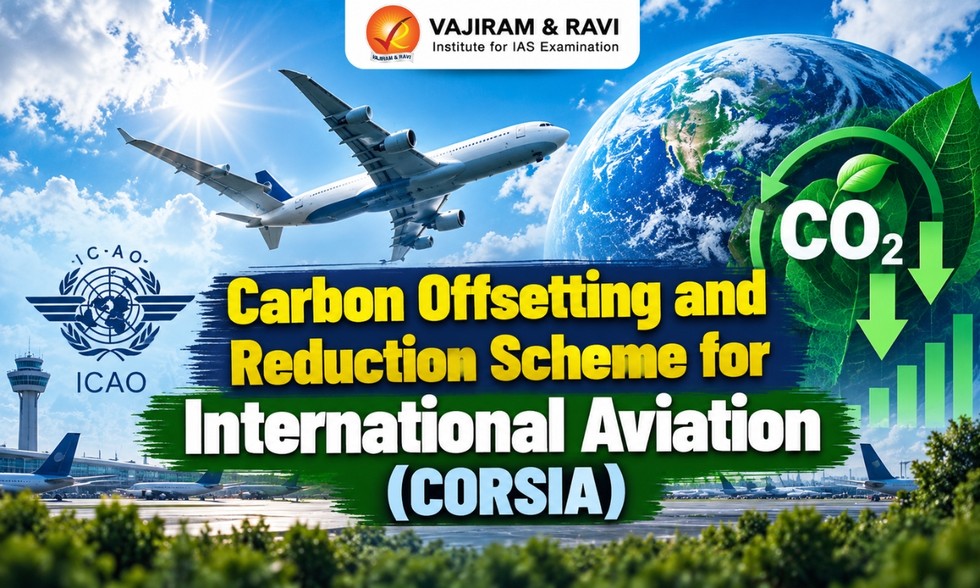
About Carbon Offsetting and Reduction Scheme for International Aviation (CORSIA):
- It is a global market-based mechanism to reduce carbon emissions from international flights.
- It was adopted by the International Civil Aviation Organization (ICAO) in 2016.
- It is the first global market-based measure for any industry sector.
- Under CORSIA, airlines compensate for their international flight’s CO₂ emissions by purchasing carbon offsets.
- A carbon offset is a credit for carbon reductions made by one party that can be purchased to compensate for the emissions generated by another party.
- Under CORSIA, airlines operating international flights between participating states must monitor, report, and verify (MRV) their CO₂ emissions, and purchase eligible emissions units ("offsets") to compensate for growth in emissions above an established baseline.
- Originally the baseline was set as the average of 2019 and 2020 emissions, but in 2020 the ICAO Council adjusted the baseline to 2019-only levels to prevent the COVID-19 collapse in air travel from making the scheme unduly stringent.
- CORSIA only applies to international flights. Domestic emissions fall under the scope of the UNFCCC and are covered by the Paris Agreement.
- The scheme runs in phases:
- A pilot phase (2021–2023) and first phase (2024–2026), both voluntary, in which roughly 120+ states have volunteered.
- A mandatory phase (2027-2035), covering all ICAO member states except those exempted (least developed countries, small island developing states, landlocked developing countries, and states with very small shares of international aviation activity).
- Compliance reports covering 2024‑2026 emissions are due to national authorities by 31 January 2028.
- Environmental Integrity:
- There are several ways to achieve CO₂ reductions that can be used as offsets, many of which bring other social, environmental, or economic benefits relevant to sustainable development.
- Such offsets can be sourced from various types of activities, including, for example, the deployment of renewable energy, clean cooking technologies, methane capture, forestry, and other emissions-reducing projects.
- To ensure the environmental integrity of CORSIA, the ICAO Council periodically approves a list of programs that can supply CORSIA Eligible Emissions Units (EEUs) to be used for compliance.
Key Facts about International Civil Aviation Organization (ICAO):
- ICAO is a United Nations (UN) specialized agency, established in 1944 by the Convention on International Civil Aviation (1944), known as the Chicago Convention.
- It is dedicated to developing safe and efficient international air transport for peaceful purposes.
- Member countries: It consists of 193 Member States
- Headquarters: Montreal, Canada.
- Governance:
- ICAO Assembly: It is convened every three years, is the organization’s sovereign body, comprising all 193 signatory States to the Chicago Convention.
- ICAO Council: It consists of 36-member, elected by the 193 Member States during the Assembly, and serves as the governing body for a three-year term.
- Functions:
- It sets standards and regulations necessary for aviation safety, security and facilitation, efficiency, and economic development of air transport as well as to improve the environmental performance of aviation.
- It also serves as a clearinghouse for cooperation and discussion on civil aviation issues among its 193 member states.
- It also promotes regional and international agreements aimed at liberalizing aviation markets.
- It helps to establish legal standards to ensure that the growth of aviation does not compromise safety and encourages the development of other aspects of international aviation law.
Environment
Current Affairs
Oct. 22, 2026
Mussel
Recently, the ICAR-Central Marine Fisheries Research Institute (ICAR-CMFRI) unit at Vizhinjam has launched its first full-fledged open-sea mussel longline farming unit.
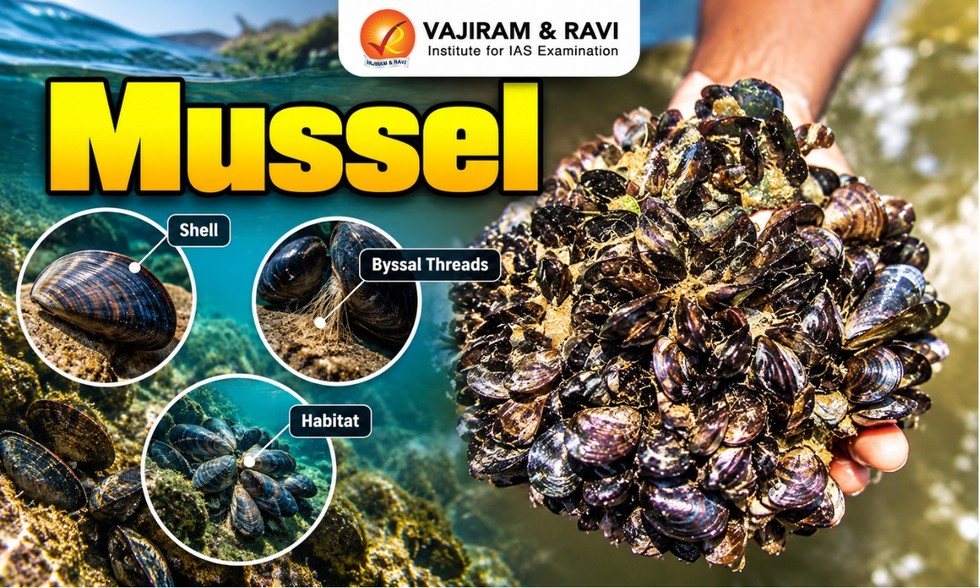
About Mussel:
- It is a bivalve of mollusks belonging to the marine family Mytilidae and to the freshwater family Unionidae.
- Distribution: They are most common in cool seas. Freshwater mussels known as naiads inhabit streams, lakes, and ponds over most of the world.
- Features of Mussel
- Appearance: Marine mussels are usually wedge-shaped or pear-shaped
- They may be smooth or ribbed and often have a hairy covering.
- The shells of many species are dark blue or dark greenish brown on the outside; on the inside they are often pearly.
- They attach themselves to solid objects or to one another by proteinaceous threads called byssus threads.
- They often occur in dense clusters.
- Benefits of Mussel:
- Food Source: They are edible and considered nutritious, rich in protein, omega-3 fatty acids, and various vitamins and minerals.
- Pearl Production: Freshwater mussels are used for pearl cultivation.
- Ecological Role: These species are filter-feeding organisms that absorb a range of contaminants into their tissue, including invisible microplastics.
- They have been used globally for decades as a barometer of marine pollution.
Environment
Current Affairs
Oct. 22, 2026
Centaurus X-3
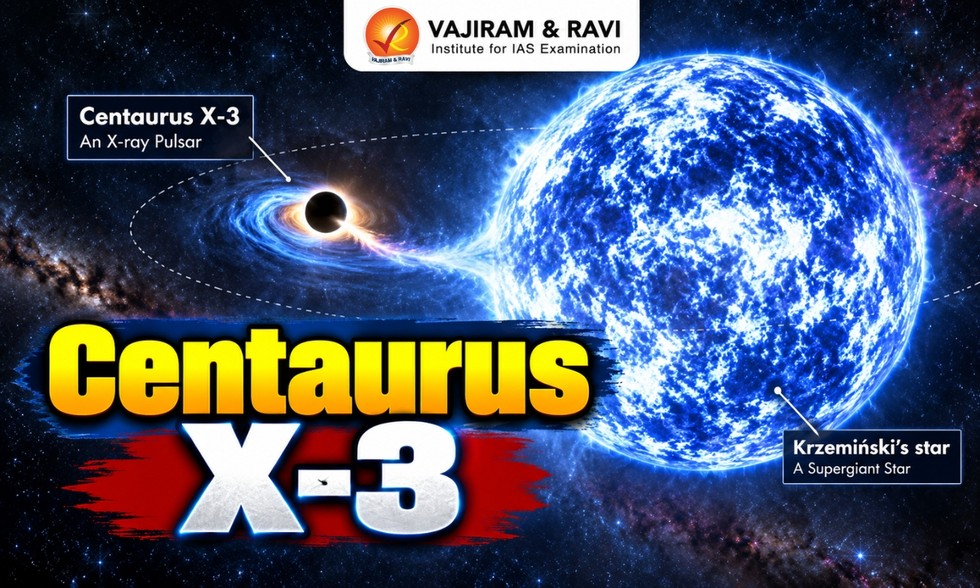
Scientists have discovered that one of the brightest X-ray pulsars, Centaurus X-3 is gobbling up material through an accretion disk.
About Centaurus X-3:
- It is one of the brightest X-ray pulsars discovered in the constellation Centaurus.
- It is a high-mass X-ray binary (HMXB) where the companion is more than 10 times the Sun’s mass,
- Location: It is located approximately 24,000 light-years from Earth.
- It contains a disk-fed pulsar with a period of 4.84 seconds that is in a 2.087 day orbit around an O-star companion.
- An X-ray binary pulsar consists of a pulsar— a highly magnetised neutron star, and a Sun-like star bound in a gravitational dance.
- A neutron star is a celestial body with the mass of our sun crunched into a ball the size of Bangalore.
- In an X-ray binary, the pulsar’s extreme gravity pulls in material ejected by its companion star, and the pulsar starts accreting material from it, shooting out X-rays in the process.
What are Pulsars?
- These are rapidly rotating neutron stars that blast out pulses of radiation at regular intervals ranging from seconds to milliseconds.
- Pulsars emit radiation from their magnetic poles, known as the primary emission.
- Pulsars have very strong magnetic fields, which funnel jets of particles out along the two magnetic poles. These accelerated particles produce very powerful beams of light.
- Pulsars have been primarily observed at radio wavelengths.
Science & Tech
Current Affairs
Oct. 22, 2026
SUVIKALP Tool
Recently, SUVIKALP received national recognition through the SKOCH Gold Award 2026 under the category “Digital Operational Efficiency – Data Driven Decision Making”.
About SUVIKALP Tool:
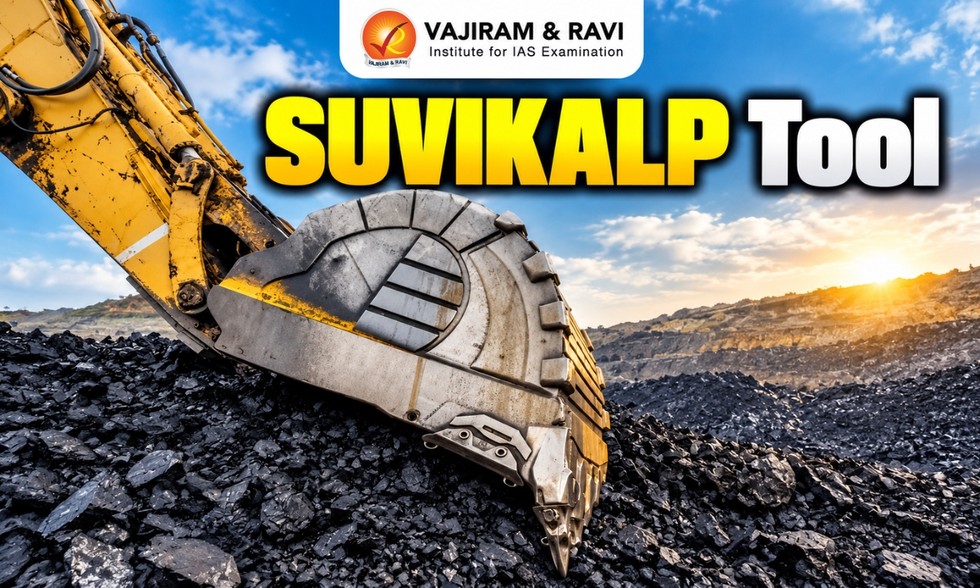
- It is an in-house Mine Repurposing Tool.
- It is developed by the Coal Controller Organisation (CCO), under the Ministry of Coal.
- It assists stakeholders in selecting suitable mine repurposing projects through a structured and data-driven decision-making process.
- The tool evaluates and ranks repurposing projects based on multiple technical, environmental, social and economic criteria.
- Working:
- Once a suitable project is identified, users can explore implementation pathways through PRISM (Post-Mining Repurposing Implementation Strategy Model).
- PRISM provides project concepts, implementation approaches, case studies, sample Detailed Project Reports (DPRs), tender documents and information on agencies working in similar sectors.
Key Facts about Coal Controller Organisation:
- Coal Controller Organization (earlier Coal Commissioner), established in 1916, is one of the oldest offices in Indian Coal sector.
- It is a subordinate office under Ministry of Coal.
- It collects and maintains coal production data of all private and public sector coal mines in the country. The information is collected on monthly basis.
- Key Functions of Coal Controller Organisation:
- It does inspection of collieries so as to ensure the correctness of the class, grade or size of coal.
- It issues directives for the purpose of declaration and maintenance of grades of coal of a seam mined in a colliery.
- It acts as the appellate authority in case of dispute between consumers and owner arising out of declaration of grade and size of coal.
- It regulates disposal of stock of coal or the expected output of coal in the colliery.
- It grants opening / re-opening permission of coal mine, seam or a section of seam or to sub-divide a mine.
- Submission of monthly coal data to different ministries of Central and State Government, national and international organization.
Polity & Governance
Current Affairs
Oct. 22, 2026
Low Level Light Weight Radar
Recently, the Ministry of Defence has signed a contract with Bharat Electronic Limited (BEL) to procure Improved Low Level Light Weight Radar (LLLR-I) at a cost of approximately ₹ 770 Cr.

About Low Level Light Weight Radar:
- It is a next-generation, multi-mission radar designed to detect and track different types of aerial targets.
- Design:
- The radar's four antenna panels are mounted on tripods and are passively cooled.
- This system does not require mechanical movement or liquid cooling.
- It features a built-in self-test function to help identify technical issues.
- It operates via a control and display unit (CDU) which allows operators to remotely control radar modes and view the air situation through a human-machine interface.
- Features of Low Level Light Weight Radar
- Coverage: It uses four fixed phased-array antenna panels to provide complete 360-degree surveillance.
- Technology:
- Active Electronically Scanned Array (AESA) technology: The system uses Active Electronically Scanned Array (AESA) technology, which allows it to electronically direct radar beams rather than physically move the antenna.
- It also incorporates Gallium Nitride (GaN) amplifiers and digital beamforming technology to improve radar performance.
- Three-Dimensional Processing: It uses advanced three-dimensional processing capabilities to distinguish targets from unwanted radar returns and reduce the effects of multipath interference.
- It is crucial for detecting small drones and other low-RCS (low radar cross-section) targets.
- Tracking:
- It can automatically track targets while continuing to scan the surrounding airspace through its Track While Scan capability.
- It can also prioritise detected aerial targets, allowing the Army to identify threats that require attention.
- Its monopulse tracking technique provides accurate target tracking in elevation.
- It has ability to provide target information to weapon systems through wired or wireless communication links.
- Electronic Counter-countermeasure (ECCM) Capabilities: It also incorporates ECCM capabilities, designed to help maintain radar performance in the presence of electronic interference.
- Adoptability: It is light weight operable in plains, desert and high altitude terrain.
- It has the capability of detecting and tracking fighter size targets and mini/ micro drone and also has additional capability of prioritizing aerial targets.
Science & Tech
Current Affairs
Oct. 22, 2026
Diamondiyne
Recently, scientists have created a new form of carbon called diamondiyne.
About Diamondiyne:
- It is a newly synthesized, three-dimensional carbon allotrope.
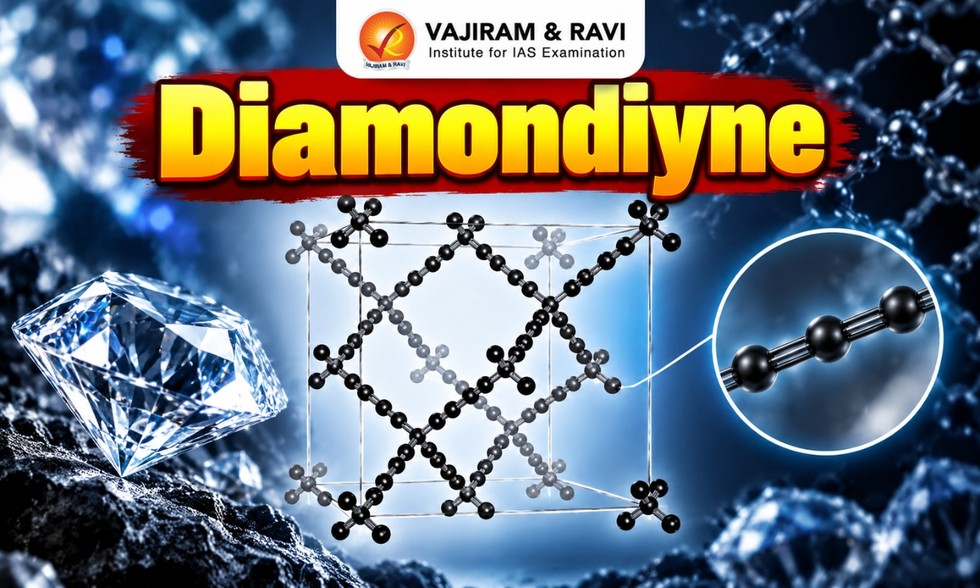
- It consists of a three-dimensional network of carbon atoms that resembles a diamond but with a more open structure.
- It is created using relatively inexpensive equipment, with the material forming as a thin film where two liquids meet.
- The researchers describe diamondiyne as a carbo-mer of diamond: diyne units are inserted between carbon centres in the diamond-topology network, expanding the structure.
- Structure:
- Diamondiyne crystallizes with the carbon atoms arranged as tetrahedra connected corner to corner in all three dimensions.
- It preserves the overall diamond-like topology but incorporates carbon atoms with different bonding arrangements.
- The ideal diamondiyne model has a face-centred cubic crystal structure, with sp and sp³ carbon in an 8-to-1 ratio.
- The structure combines sp-hybridised carbon atoms, which participate in triple bonds, with sp³-hybridised carbon atoms connected through single bonds.
- The resulting diyne groups expand the repeating network compared with diamond, creating more space within the structure. (The ‘y’ in the material’s name comes from the presence of carbon-carbon triple bonds.)
Science & Tech